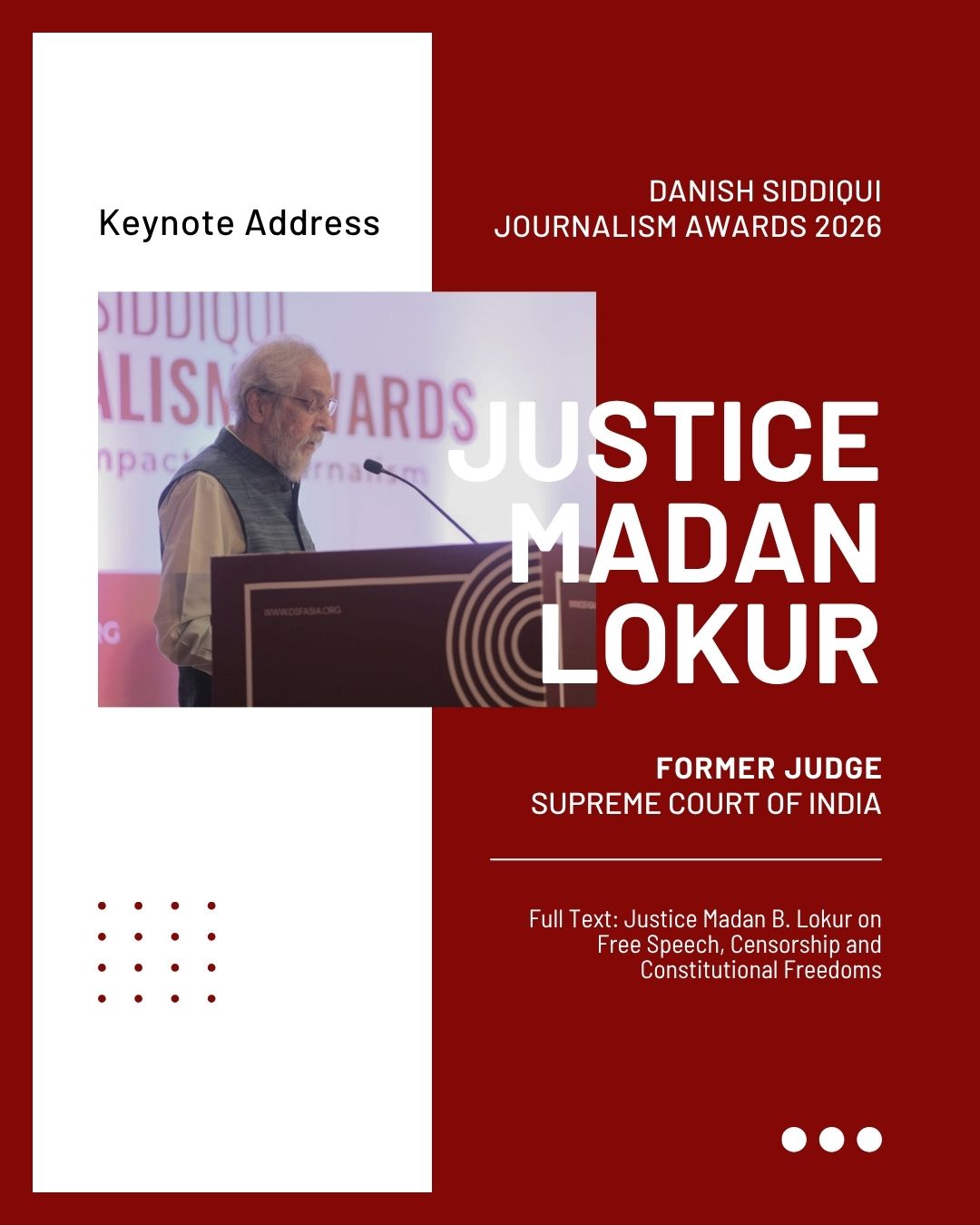
The following is the full text of the keynote address delivered by Justice Madan B. Lokur at the Danish Siddiqui Journalism Awards 2026 in New Delhi. The views expressed in this speech are those of the speaker alone and do not necessarily reflect the views of the organizers or the foundation. Republishing, in whole or in part, is permitted provided appropriate attribution is given to the speaker and the Danish Siddiqui Foundation.
At the outset, I would like to say a few words about Danish Siddiqui, a photojournalist of eminence. Unfortunately, he passed away while on an assignment in Afghanistan in 2021 at the young age of 38 years. However, during his lifetime, he achieved great recognition and was twice awarded the Pulitzer Prize, in 2018 and posthumously, in 2021. In late 2021, he was posthumously awarded the Journalist of the Year 2020 by the Mumbai Press Club. While presenting the annual Red Ink Awards for Excellence in Journalism, the then Chief Justice of India described him as a man with a magical eye, rightly regarded as one of the foremost photo-journalists of this era. He said, “If a picture can tell a thousand words, his photos were novels.”
We have long discussed our fundamental right to freedom of speech and expression and freedom of the Press guaranteed under Article 19(1)(a) of our Constitution. We have also discussed restrictions and curtailment of this right over the years. I would like to discuss the aggressive use of censorship as another form, though of somewhat recent development, of curtailment of this fundamental right.
During the Constituent Assembly debates, some honourable members suggested including freedom of the Press as a separate fundamental freedom. I would imagine this suggestion was made given the history of gagging the Press during the British Raj by invoking a variety of laws. One of the more celebrated cases that most of us have read or heard about is that of Bal Gangadhar Tilak being charged and convicted of sedition for his writings. However, Dr. Ambedkar was quite clear that freedom of speech and expression encompassed freedom of the Press and his view was accepted. During the debates, he categorically stated:
“The press is merely another way of stating an individual or a citizen. The press has no special rights which are not to be given or which are not to be exercised by the citizen in his individual capacity. The editor of a press or the manager are all citizens and therefore when they choose to write in newspapers, they are merely exercising their right of expression, and in my judgment therefore no special mention is necessary of the freedom of the press at all.”
The view expressed by Dr. Ambedkar was accepted by the Supreme Court in among the first few cases decided in 1950, that is, in the case of Romesh Thapar. The Governor of Madras (not the same person we have heard so much about, but somebody else) had prohibited circulation of the weekly newspaper Cross Roads in the then state of Madras. The prohibition was challenged in the Supreme Court and while quashing the prohibition, it was held that, “…freedom of speech and of the press lay at the foundation of all democratic organisations, for without free political discussion no public education, so essential for the proper functioning of the processes of popular government, is possible.” Incidentally, and by way of trivia, the case was filed in February 1950 and decided three months later in May.
Since the pronouncement by the Supreme Court more than 75 years ago, it has been widely accepted, without demur, that freedom of the Press is integral to freedom of speech and expression.
In addition to this case, restrictions on the freedom of the Press were placed but of a non-violent nature in the sense that in the case of Sakal Papers, the Newspaper (Price and Page) Act read with the Order enacted thereunder placed a direct linkage between the number of pages in a newspaper and the price at which it was sold. This obligated the newspaper Sakal to either reduce the number of pages or to increase the sale price. On a challenge made, the Supreme Court held the Act and the Order were unconstitutional and also stated the obvious, namely, that the only restrictions which may be imposed on the rights of an individual under article 19 (1) (a) are those which Article 19 (2) of the Constitution permits and no other. A similar restriction on the availability of imported newsprint and limiting the size of a newspaper to 10 pages was struck down by the Supreme Court in the case of Bennett Coleman a few years later.
During the internal emergency between 1975 and 1977, restrictions on the freedom of the Press began taking a somewhat violent turn with aggressive censorship coming into the picture. The Indian Express was a victim of this censorship and on several occasions, the newspaper was published with blank columns clearly pointing to censorship. That this happened during the Emergency is not surprising if one keeps in mind the words of the Supreme Court that freedom of the Press is “so essential for the proper functioning of the processes of popular government.”
The Emergency hangover continued and the Indian Express was again under attack, this time regarding its building on Bahadur Shah Zafar Marg. (Miraculously, the name of this street has not yet been changed). It was alleged that the construction by Indian Express was unauthorised. Notices for forfeiture of the lease and re-entry were issued with threats of demolition, similar to the bulldozer justice we are witnessing these days. The Supreme Court once again came to the rescue of press freedom and characterised the notices as arbitrary and illegal while striking them down.
One would have thought that our political dispensations would have appreciated that violent attacks on the freedom of the Press yield no results but that was not to be. In the last several years, we have come to witness some more serious violent attacks on the freedom of the Press through silencing journalists and the use of other subtle and not so subtle techniques.
Violence against journalists
Let me begin with violence against some journalists. An extreme example has been the case of Gauri Lankesh. Her views as an eminent journalist were well known and impactful, but not to the liking of those fanatically opposed to them. She was murdered outside her home in September 2017. Her murder had a freezing effect on journalists and free speech activists. Eight years have gone by since the heinous crime, but the trial is yet to conclude and it is difficult to say when one can see a conviction, if at all.
A somewhat lesser evil was the incarceration of Siddique Kappan in October 2020. He was a journalist travelling to Hathras to cover the gruesome gang rape and subsequent death of a Dalit woman. While on the way, he was arrested on very serious charges including those related to sedition and the Unlawful Activities (Prevention) Act. He spent more than two years in jail and the status of the trial does not appear to be in the public domain.
There are multiple instances of the murder of journalists, their incarceration, but they will take time to recount. There have also been killings of Right to Information activists who are also serving the cause of the freedom of speech and expression. They all deserve our respect and also deserve to be honoured.
There have also been less violent instances of abrupt and overnight termination of services of the editor of a popular newspaper by the management under pressure and compelling circumstances. These instances, individually and collectively, have had a chilling effect on the community of journalists, over and above the earlier freezing effect, and have constrained some of them to report only news that is in favour of the political dispensation, nationally and regionally, and news that is fit to print. This has resulted in the widespread use of the expression godi media. Is this turn of events for the benefit of the country and does it not dampen the freedom of speech and expression including the independence and freedom of the Press? These are some questions that arise on a day-to-day basis.
In my opinion, having achieved control, to a large extent, over the media, both print media and television, national and regional, the manner of control is shifting to a comparatively non-violent form, that is, through censorship. The unfortunate trend in recent times has been curtailment of freedom of speech and expression by the state through a variety of ways, some of which I propose to advert to.
Restrictions on universities
Delhi University, one of the finest in the country, has been a victim of unreasonable regulation of this right. A ban on protests and demonstrations was imposed for a month sometime in February this year. Later, in March, an order was issued restricting any assembly/ gathering/ protest/ demonstration/ march/ procession or similar activity. The organiser of such a “programme” that is protest, public speech, dharna, rally etc., is required to make an application, furnish a list of speakers and so on and intimate not only to the University authorities, but also the police at least 72 hours in advance. The authorities may, of course, refuse permission. The ostensible reason for this clampdown is that the protests may turn violent and would make it difficult for the police to maintain law and order. In a somewhat different situation, a senior judge of the Allahabad high court observed, “If the superintendent of police (SP) and district magistrate (DM) believe that a law-and-order situation may arise due to a large number of people offering prayers inside the premises, they should either resign from their posts or seek a transfer out of Sambhal.” The remark would be apposite so far as Delhi University is concerned. If the police cannot control a law and order situation, he or she must resign or seek a transfer out. In this context, less said the better about Jawaharlal University.
Even otherwise, it has become difficult for researchers and scholars to visit Universities or participate in seminars for reasons that are sometimes frivolous or not clear. Last week a Professor of Law from Sri Lanka was invited to a National Law University for a series of lectures, but getting a visa was so difficult that she cancelled her trip but agreed to deliver the lectures online. Who benefited from this?
Restrictions on screening films
The Ministry of Information and Broadcasting blocked the screening of a Malayalam animated short film of 7 seven minutes at the Animela Animation Festival in Mumbai in February this year. The film called Da’Lit Kids, has won multiple awards at different film festivals. Screening this film was denied at the behest of the concerned Ministry, without any explanation but ostensibly since it deals with caste realities.
In the Kerala Film Festival and the Goa film Festival, the movie The Voice of Hind Rajab was not certified for screening since it narrated the story of a 5 year old girl who died in the Gaza war. Certification for orally refused apparently on the ground that it would adversely impact India’s relations with Israel.
What took the censorship cake was the ban on screening the 1925 classic silent movie Battleship Potemkin without reason in the Kerala Film Festival. It is surmised that the ban was on the ground of some Russian connection. Similarly, Charlie Chaplin’s The Great Dictator was also prohibited from screening and nobody seems to know why. Both were subsequently cleared for screening. However, the question is why was the ban imposed?
Restrictions on social media
It has been widely reported that in 2024-25 the government issued over one lakh take down orders, with an unbelievable average of about 290 take down orders per day. The reasons for online censorship were many, including objections to posts about Ministers and the government. Surely, freedom of speech and expression demand greater respect. Are we to understand that responsible government officials are spending their working day surfing the Internet and searching for posts and pictures that may be considered objectionable and reporting them to superior officials who then issue takedown orders? Surely, we deserve a better governance structure.
Last year, a professor was arrested for social media posts regarding Operation Sindoor on the ground of endangering national security and promoting enmity between groups. His arrest was criticised by academics who described it as a form of censorship. He was granted bail by the Supreme Court which constituted an SIT to investigate what he really meant in his posts. After an investigation, it transpires that the Professor meant nothing other than what he had posted – there was no hidden meaning. He was also restrained from making any online references to the posts.
On the other hand, no action was taken against a minister in Madhya Pradesh for making completely unwarranted and unpalatable remarks about a female Army officer and spokesperson on behalf of our country during the same Operation Sindoor.
While the Constitution of India permits the state to place reasonable restrictions on the freedom of speech, expression and the press through a law enacted by parliament, we are now witnessing restrictions being placed by non-state actors in situations beyond the rule of law and this is rather disturbing. What the state may be permitted by law enacted by parliament, is now being taken over by some individuals and groups or non-state actors. I propose to cite a few examples of this.
Restrictions on books by non-state actors
In the Bihar State Museum in Patna which, by the way, is an excellent museum, a Children’s LitFest was recently held. A comic book titled Chudail was on display in the stall of a publishing house. A visitor asked what the comic book was about and was told that a chudail or a witch enters the body of a woman to show her how unfair is her life. On being asked and told the caste of the woman, he created a ruckus calling the publishing house anti-Brahmin and anti-national. The next day, the organisers dismantled the book-stall.
In Mumbai, a discussion on the book The Cell and the Soul: A Prison Memoir by Anand Teltumbde was scheduled in the Kala Ghoda Arts Festival. It is reported that the Municipal Corporation, the Maharashtra Tourism Department and UNESCO were the primary collaborators of the Arts Festival along with some private companies and Mumbai Police as supporting partners. Social media posts suggested that the Arts Festival promoted an urban naxal and an anti-national book and person. Social media posts apparently prompted the police, a supporting partner, to cancel the book discussion. The incident added a new phrase ‘cancel culture’ to our vocabulary.
Restrictions on movies and names
The movie Padmavati was due for release in 2018 but a non-state organisation strongly objected to the portrayal of the respected Rani Padmavati and a distortion of history. The protests and the consequent furore went up to the Supreme Court which permitted release of the film invoking freedom of speech and expression, but the film makers could release the movie only after its name was changed to Padmavat so that reference to the brave queen is removed.
Another name led to a wholly unnecessary and petty controversy in the town of Kotdwar in Uttarakhand. A non-state group objected to an old tailor using the name Baba on the banner of his shop – a name he had been using for several years. When the group went to browbeat the tailor, the owner of a gym in the vicinity went to support the tailor. He was asked to identify himself and he did so as Mohammad Deepak. This was enough to set off a chain of events with a dharna outside his gym, loss of customers and worse, a case against him for breach of peace. Mohammad Deepak, your friendly neighbourhood citizen, approached the Allahabad high court seeking protection and security from the non-state actors but was told that being accused of an offence, he was not entitled to any security. Fortunately for him, some lawyers from the Supreme Court have taken membership of his gym so that he is not financially distressed.
I can recite a list of such episodes of online and offline censorship for another couple of minutes but must stop at some time.
Conclusion
So now, we have restrictions on freedom of speech and expression not only by the state but also by non-state actors. This is not only disturbing but distressing. Have we given up the rule of law and replaced it by the rule of non-state actors? What is the law and order machinery doing about it?
Jurists and academics have described our Constitution as transformative but it appears that it is itself undergoing a transformation. In other spheres, we have been witnessing the refusal by the governors of some states to enact a law passed by the state legislature and to withhold consent for several months if not a couple of years. The Supreme Court has had to intervene and grant relief but I wonder if this is only temporary. Some Governors have declined to perform the formality of reading the text of the speech prepared by the Cabinet at the opening session of the state legislature. We have also had the unedifying situation of the Speaker of the state legislature taking his own time to decide on anti-defection petitions again compelling the Supreme Court to intervene. Concerns of constitutional morality are mounting on a daily basis and side-by-side, we are witnessing an erosion of our fundamental right to speech, expression and the Press. Severe restrictions have already been placed on the fundamental right to peacefully protest and in Delhi, a designated place has been identified for protest. Even for protesting at that place, prior permission must be taken, and it can be refused.
With these momentous changes taking place, we need to ask ourselves one question: where does our Constitution stand on our fundamental freedoms and where do we stand on our fundamental freedoms?