The views expressed in this speech are solely those of the speaker and do not necessarily reflect the views of the organizers or the foundation. Republishing any part of this content is permitted with appropriate credit to the speaker and the Danish Siddiqui Foundation.
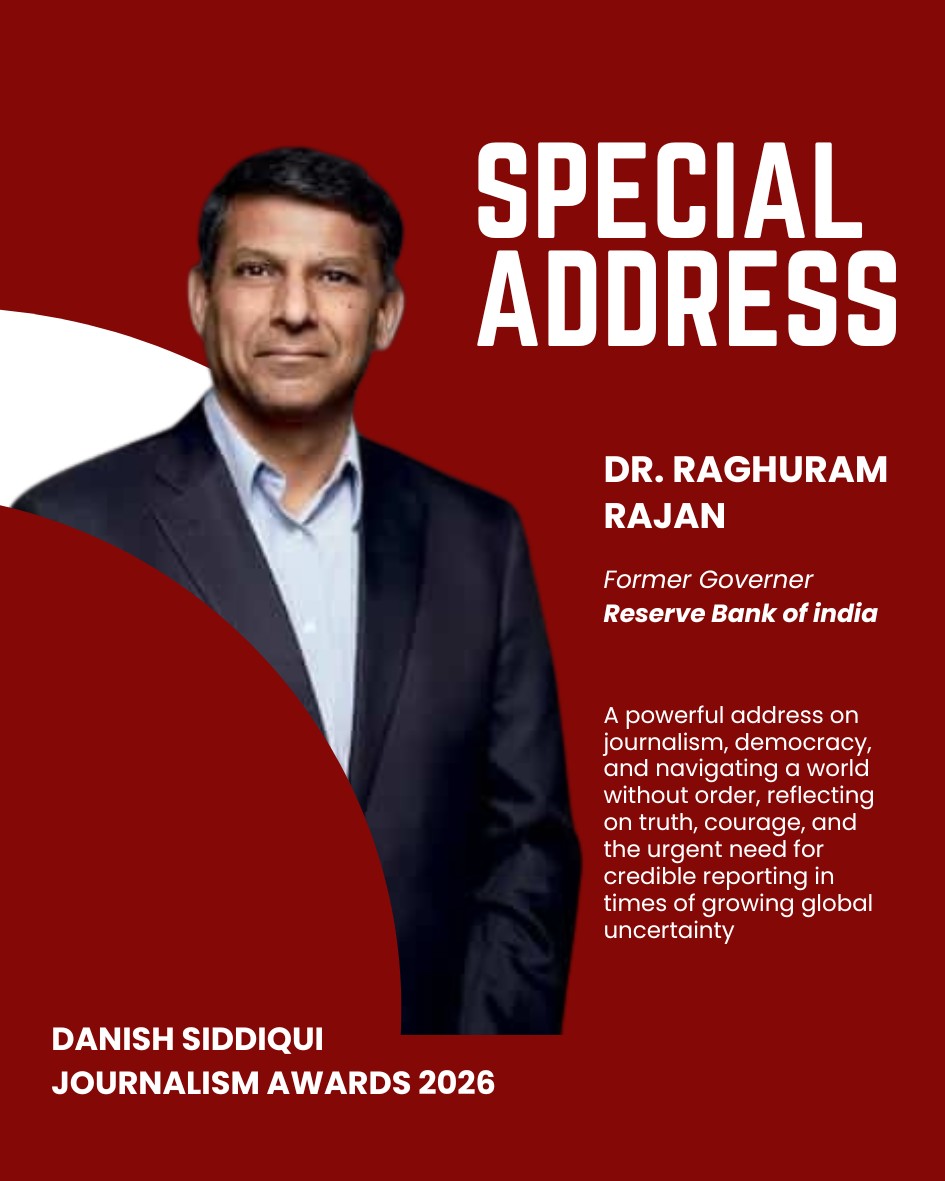
Honorable Justice Lokur and distinguished guests,
I am grateful to the organizers for inviting me to speak on the occasion of the Danish Siddiqui Journalism Award.
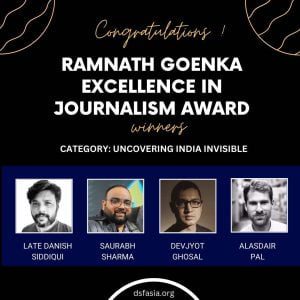
Danish Siddiqui was a journalist who would not let us look away. Through his lens, he forced us to confront the brutality of state violence and the quiet cruelty of indifference, refusing us the comfort of ignorance, the easy fiction that we did not see and therefore did not know. One of the finest journalists of his generation, he was snatched away brutally when there was still so much he had to contribute. What endures, however, are his photographs, unflinching, unyielding, silent witnesses to a world that demands to be changed. I called him a fearless journalist just now, but that does him injustice.
No one truly sane is without fear. What Danish possessed, I believe, was an abundance of courage, the courage to step into danger, camera in hand, knowing that each step closer to the truth might also be a step towards his own end. Largely self-taught, he won two Pulitzer Prizes. To the young journalists here today, his life is a testament not just to talent, but to what dedication, moral clarity, and courage can achieve. He also reminds us of the responsibility to bear witness and to expose the injustices that run through our world.
Evil is inherent in man’s nature, and we cannot end it completely. But we must never condone it or allow ourselves to turn a blind eye to it.
Danish helped us do that.
A More Dangerous World
Unfortunately, the world has become even more dangerous in the years since Danish’s passing. The two big economic superpowers are behaving in short-sighted, self-interested ways.
To extract short-term bargaining advantage, the United States is dismantling a world order which worked really well for it, and for many others too. Meanwhile, China continues with a manufacturing-intensive, export-led economic growth model that no longer works for it or for the rest of the world.
Increasingly, though, superpower growth will come at the expense of others. As the superpowers impose economic and military policies that serve their interests on everyone else, this is a behavior that political scientists term predatory hegemonism.
India in a World Without Order
Now, how can a middle power like India navigate this world without order, where there is no constraint on military behavior, but also where cross-border trade and investment are sources of vulnerability, and payments and financial investments can be weaponized?
Almost surely, a key part of the answer is more economic growth, even while we attempt to make our economy more resilient to shocks like the one emanating from the conflict in the Middle East. I have spoken at length about this elsewhere, so let me speak briefly about other key elements of national security, that is, national unity and friendship with nations.
National Unity and Democracy
A democracy and a fair judicial system unite India. They allow our differences to be negotiated rather than becoming a source of conflict, and allow our diversity to be a source of strength rather than a source of divisiveness. As the international environment turns dangerous, we cannot afford to exacerbate domestic fissures by demonizing our fellow citizens based on their religion, caste, tribal identity, gender, or state of mind or origin.
India does not, however, need a police state where every offhand remark or careless tweet could attract an FIR and a sojourn in jail. Such a state would chill free speech, an essential foundation for democracy. Even less does it need an unjust police state that prosecutes speech and bulldozes houses of certain communities only.
What we do need, however, is firm and even-handed restraint of truly hateful speech by leading politicians and other leaders. Restraint that must come either from the parties of these politicians or, failing that, from the Election Commission and the courts.
If the natural divisions within our society are not to harden into irreparable schisms, our institutions must rise in this moment and demonstrate clearly and credibly that justice still resides within them.
Role of the Press
The press undoubtedly also has a role, shining a light on injustice in the way Danish did, but also shining a light on institutions that fail us.
As much as institutional functionaries fear what will happen to them if they go against those in power, they should also worry about being exposed if they go against the people.
Rebuilding Regional Relationships
Now let me turn to building friendships with other countries.
Start with neighbors. The way to build closer relations often is small, basic steps. Unfortunately, we do not enjoy good relations with many of our neighbors, even those we have helped significantly over past decades. Yet their friendship is worth having and worth seeking out.
A South Asian free economic zone would bring a huge number of consumers together, an important asset in an uncertain future world. What if we could also undertake joint military exercises and joint anti-terrorist actions, and we did not have to maintain massive military forces on our borders? Now, I do realize antagonisms run deep with some neighbors. Vested interests on both sides of the border have an interest in keeping conflict going, so it would be naive to expect quick rapprochement.
Let us reach out a hand to some of our small neighbors, as we are doing with Sri Lanka, to show what is possible. Let us build educational, cultural, and trade ties, offer responsible and transparent investment support, and develop joint positions on common issues like climate change, where we speak with the rest of the world. And almost certainly, let us use our common love for cricket to repair hostilities rather than exacerbate them.
Working with Middle Powers
Finally, let me end with India joining with the middle powers.
In a world with two formidable superpowers, middle powers have to work with each other to rebuff coercive pressures, as Mark Carney indicated in his Davos speech. Divided, we will be cowed by the superpowers. United, we can push back for fairer outcomes. If we are to work with other countries, though, they have to see us as reliable friends.
Values vs Transactional Politics
Fortunately, we have drifted from a values-based approach to international relations to a transactional approach, where instead of doing what is right by our values, we do what is convenient for us in the moment.
I hope our decision-makers now see how wrong this is. We enjoyed criticizing the occasional hypocrisy of a values-based approach. But that approach is far better than the unmitigated brutality of a transactional approach dominated by power. An approach to other countries anchored in our historic democratic values of tolerance and respect, and where our government emphasizes these values with both talk and action, makes us more reliable and allows us to make common cause with democratic middle powers that are our natural friends in this world without order.
Conclusion
The world could go back to more ordered international relations, though we will not go back to the status quo ante.
The memories of what has happened cannot be erased. Hopefully, the United States may once again appreciate the beneficial aspects of the order it is dismantling. China may finally change its disruptive economic model.
In the meantime, though, India has to take the world as it is. We need to be clever in navigation. But we do have our strengths, including our population, our democracy, our diversity, and our energetic youth. To succeed, we will have to stop fighting the battles of the past that divide us. Instead, we have to prepare for new opportunities while addressing the inequalities and the injustices of the world we live in.
I hope the idealistic journalists who are here today, including the recipients of the award, will, inspired by Danish Siddiqui’s life, help guide us forward.
Thank you very much.