
Rethinking Migration: Azadi to Co-Exist
Triveni Kala Sangam
2024
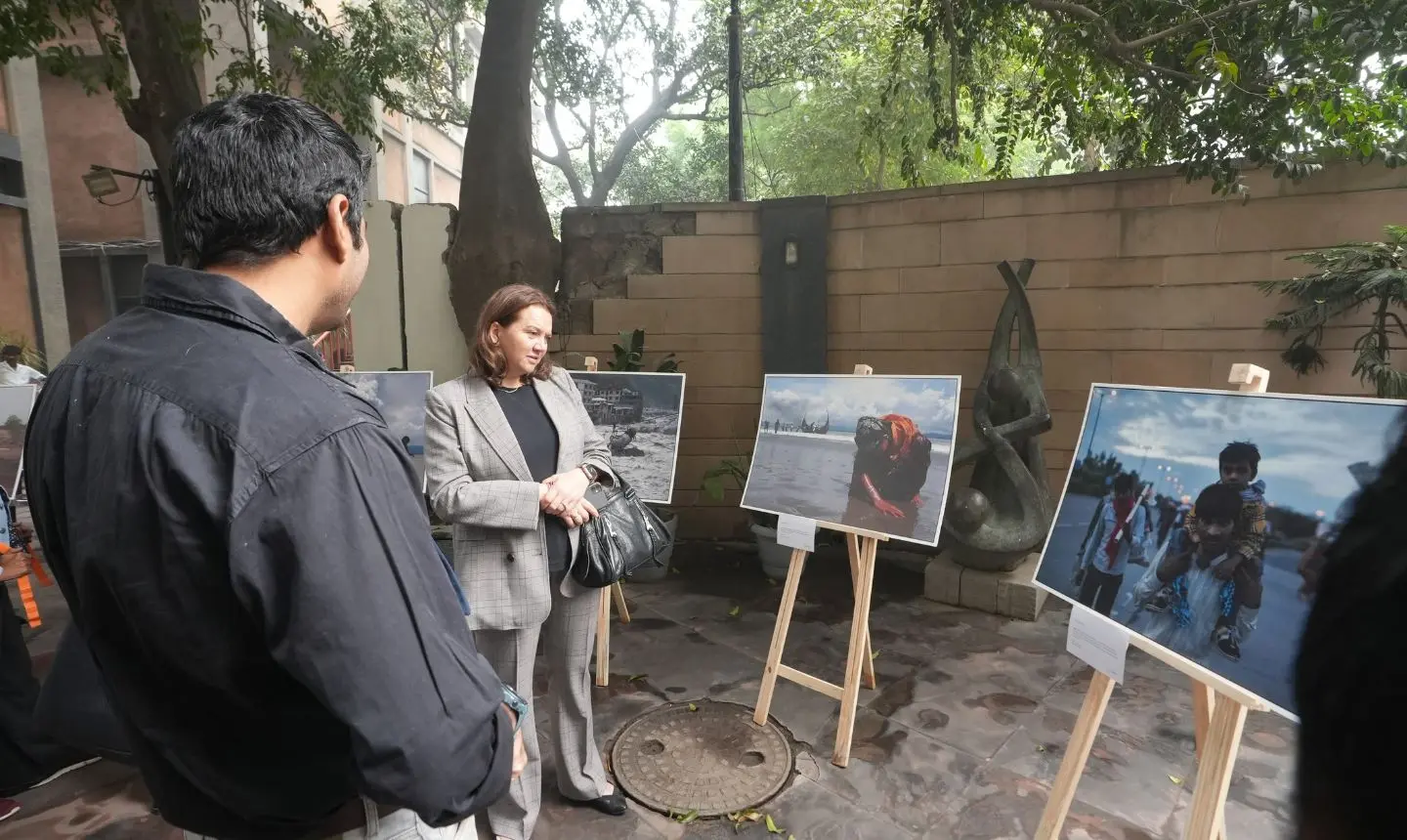
The exhibition explored migration, displacement, and resilience through powerful photography, bringing together diverse perspectives on forced migration while encouraging dialogue, understanding, and reflection on human experiences.
A special tribute was paid to Danish Siddiqui, a two-time Pulitzer Prize-winning photojournalist whose impactful storytelling continues to inspire the next generation of visual journalists. His commitment to documenting human experiences with courage, empathy, integrity, and truth remains at the core of this initiative.
The exhibition featured the works of acclaimed photographers, each contributing a unique visual narrative that captured the essence of migration. Their dedication to impactful storytelling underscored the power of photography in shaping public perception and fostering social change.
“Rethinking Migration: Azadi to Co-Exist” was an exhibition and a call to reflect on the realities faced by displaced communities worldwide. By amplifying these voices through visual storytelling, the event reaffirmed the role of journalism in driving awareness, empathy, and action.

Arati Kumar-Rao is an independent photographer, writer, and National Geographic Explorer focusing on environmental degradation across South Asia. Her work documents the impact of groundwater depletion, habitat destruction, and industrial land acquisition on biodiversity and human displacement. In 2023, she was named among BBC’s 100 Influential Women for her contributions to environmental storytelling. Her book, Marginlands: Indian Landscapes on the Brink, published by Pan Macmillan (Picador) India, was shortlisted for the TataLitLive! and Atta Galatta Awards in the First-Book (Non-fiction) category. Her work has appeared in National Geographic Magazine, Emergence Magazine, BBC, and leading Indian publications. She is currently on a National Geographic grant documenting forced human migration in India.

David Weston is an accomplished Indian photographer with a passion for capturing moments through the lens, a passion that began in his youth. His journey, shaped by academic excellence in visual communication and specialized photography training, spans a diverse portfolio. While his primary focus is on fashion, editorial, and commercial photography, his love for nature and travel has driven him to explore fine art photography. David’s work has been featured in publications like Elle, Cosmopolitan, Femina, and National Geographic. He has also worked with major platforms such as Netflix, Amazon, and Zee5. Beyond his commercial success, David is dedicated to meaningful projects, including documenting the lives of Rohingya refugees in Chennai, India, through Rethinking Refugees. His artistic roots remain central to his work, which includes showcasing fine art photography in galleries. David continues to be a compassionate and versatile presence in the photography world.

Din Muhammad Shibly is a documentary photographer based in Dhaka, Bangladesh, specializing in socio-political and environmental storytelling. His work focuses on capturing social dilemmas and conflicts, using photography as a tool to spark civic discourse and reflection. Through his lens, Shibly aims to document pressing societal issues and drive meaningful conversations.
A Chance To Breathe presents the remarkable photographs of Omal Khair, Dil Kayas and Azimul Hasson, who have been documenting their lives and those in their Rohingya refugee community living in Cox’s Bazar, Bangladesh since 2018. By telling visual stories of life, resilience and hope, their photographs help reframe the prevailing narratives of violence, death and victimhood that often describe Rohingya refugees’ experiences. In 2018, Doha Debates teamed up with Fortify Rights to equip and support these three talented photographers and give the world an inside look at the lives within the world’s largest refugee camp.
Omal Khair dreamed of becoming a professional photographer – a forbidden occupation in her indigenous homeland. Azimul Hasson used to study and play football back at home, and he still dreams of pursuing higher education there. Dil Kayas is a mother of three. Like Omal, she harboured a passion for photography, but the Myanmar government denied her the right to pursue it. These three Rohingya photographers are talented, creative and hard-working and this exhibition celebrates their vital and ongoing storytelling. The photographers kindly ask for your support by following them on Instagram, and continuing to see the stories of Rohingya lives.
Kaynat Salmani is a social worker and development aid worker. She focuses on gender equality, equity, migration and forced displacement.
Danish Siddiqui was a two-time Pulitzer Prize-winning photojournalist who headed the Reuters multimedia team in India as its Chief Photographer. Before his foray into photojournalism, Danish was a television correspondent with India’s leading news networks. As a photojournalist, Danish covered several important stories in Asia, the Middle East, and Europe. His works included covering the wars in Afghanistan and Iraq, the COVID-19 pandemic in India, Indian citizenship law protests, Sri Lanka Easter bombing victims, the Rohingya refugee crisis, Hong Kong protests, Nepal earthquakes, Mass Games in North Korea, and living conditions of asylum seekers in Switzerland. Danish’s work was widely published in scores of magazines, newspapers, slideshows, and galleries, and he was honored with various photojournalism awards globally.
Prashanth Viswanathan, a seasoned freelance photographer, brings a wealth of experience to his craft, specializing in news and assignment stories spanning the diverse landscapes of India. Since embarking on his professional journey in 2006, Prashanth has collaborated with esteemed entities such as newswires (Reuters, Bloomberg, Getty), newspapers (New York Times, International Herald Tribune, The National), and prominent magazines (Forbes, Businessweek, Time, Newsweek). His lens has also been engaged by non-governmental organizations, including UNICEF, Save The Children, International Labour Organization, and Action Aid, along with various feature agencies. Prashanth’s versatile portfolio reflects his dedication to capturing compelling narratives across different realms.
Ranita Roy is a documentary photographer, visual artist, and National Geographic Explorer from Howrah, India. In 2024, she launched her National Geographic Society-funded project, I Was Dreaming of a Snowy Mountain, in Uttarakhand. With a master’s in environmental science and training in hostile environments (HEAT) and underwater diving, she navigates diverse fieldwork challenges. Her work has appeared in The Washington Post Magazine, Reuters, and The New York Times. She has received grants from Magnum Foundation, AJWS, and The Create Fund from Shutterstock. Through her storytelling, she highlights grassroots environmental solutions and the role of women’s collectives in marginalized communities. Roy contributes to National Geographic Society’s mission by using photography to raise awareness about environmental issues. Inspired by community resilience and nature’s healing power, she continues to explore impactful storytelling. She divides her time between Kolkata and Uttarakhand, both of which shape her creative vision.

Saumya Khandelwal, a distinguished photojournalist based in New Delhi, contributes to TIME, National Geographic, and The New York Times. Recognized as a Getty Images Instagram Grantee for her project ‘Child Brides of Shravasti,’ Saumya focuses on gender and environmental issues. Her work features in National Geographic’s 100 Best Photos of the Century and TIME’s Top 10 Photos of 2021. She was nominated for the World Press Photo 6X6 Global Talent Program. Saumya has a diverse journalism and documentary photography portfolio, with notable contributions to The Wall Street Journal, Washington Post, Vanity Fair, and collaborations with NGOs like the Bill and Melinda Gates Foundation, Malala Fund, and Acumen. Saumya’s impactful work received the National Foundation of India Award in 2017 and has been exhibited globally, including at the Getty Images Gallery in London and the Foreign Correspondent’s Club in Hong Kong.

Sujata Setia is an Indian lens based multidisciplinary artist. Her practice focuses on themes of identity, displacement, ethnicity, the politics of trauma and grief. The series Invisible studies the concept of multiple marginality within the Rohingya community and the cumulative disadvantage created for Rohingya women and children. The investigations are based on intensive interviewing, participant observation and the collection of life histories. Sujata is now based in the UK nowadays.