
India's rapid economic growth and technological advancements have propelled it onto the global stage. However, the country's media industry grapples with many challenges alongside these developments.
This paper delves into the complexities of India's media landscape, with a focus on press freedom and journalist safety. Utilizing KnightLab's StoryMapJS, interactive map-based stories are analyzed to explore the diverse challenges faced by journalists, including financial, physical, digital, and psychological safety concerns. By examining detailed incident timelines for journalists Devendra Khare, Ismat Ara, and Navin Kumar, this paper provides valuable insights into media freedom's evolving dynamics and the threats journalists and media organizations encounter in India.
Overview
Journalist Safety Comes in Various Forms
In any robust democracy, the fundamental right to freedom of speech and expression is sacrosanct. This right extends to journalists and media entities, who serve as indispensable intermediaries between the populace and governing authorities. However, journalists must be guaranteed high safety and security to carry out their pivotal role effectively.
-
Financial Safety
This is paramount for journalists as it provides stability to pursue meaningful work and disseminate information in the public domain. According to the Lokniti-CSDS study 'Indian Media: Trends and Patterns,' a staggering 82% of surveyed journalists reported that their media organizations exhibited a bias towards a particular party. Additionally, 16% stated they were forced to leave their jobs due to perceived political affiliations, while 50% expressed concerns about potential job loss for dissenting against the government.
-
Physical Safety
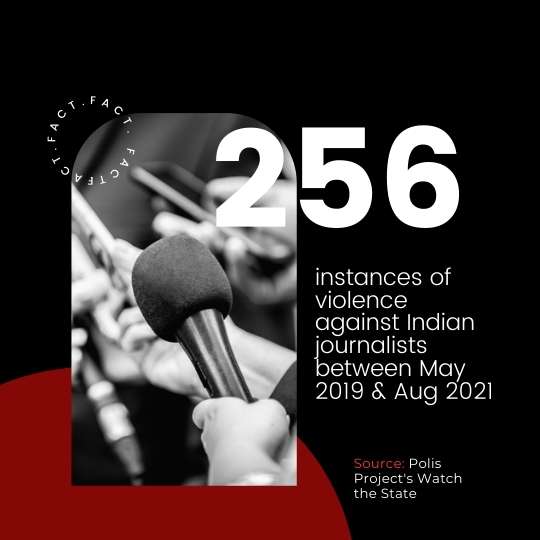
According to a report by the Rights and Risks Analysis Group (R.R.A.G.), at least 114 journalists have been targeted by the State through methods such as filing FIRs, arrests, detentions, and interrogations. The Polis Project's Watch the State documented 256 instances of violence against journalists by both state and non-state actors between May 2019 and August 2021.
-
Digital Safety
In today's digital era, ensuring journalists' safety on social media platforms is as critical as safeguarding their physical well-being. Beyond unjustified censorship, journalists often fall prey to mob mentality prevalent in online spaces. This concern is particularly pronounced for women and LGBTQIA+ journalists, who frequently encounter harassment and shaming. The "Bulli Bai Deals" case is a poignant example of this disturbing trend.
-
Psychological Safety
The various risks to a journalist's safety not only endanger their physical well-being but also give rise to a host of psychological challenges and mental health issues. Anxiety, depression, and sleep disturbances have become prevalent among journalists striving to uphold their professional standards and ethics amidst the myriad safety threats they encounter.
Case Study 01
Devendra Khare
An Anatomy of Physical Abuse
The pursuit of editorial and journalistic freedom often faces formidable challenges. Devendra Khare, a journalist based in Uttar Pradesh, exemplifies this struggle for integrity and truth. Working as a district correspondent for News1India in Jaunpur, Khare has built a reputation for unearthing stories that expose the hidden realities behind the polished facades of power.
Khare's ordeal began when he reported on a viral WhatsApp video depicting an alleged assault by a relative of a local political leader, Rituraj Singh. Despite threats and intimidation from individuals associated with Singh, Khare refused to back down. One evening, while conversing with fellow journalists outside his office, Khare was ambushed by a masked assailant who fired two shots, injuring him in the stomach and hand.
With the support of local and mainstream media outlets and journalist protection organizations, Khare's case gained widespread attention, ultimately leading to the arrest of the perpetrators. However, Khare's experience serves as a sobering reminder of the risks journalists face, particularly in regional and local contexts.
Case Study 02
Ismat Ara
Identity Compromised on Digital Media
Ismat Ara, a decorated journalist based in New Delhi, has earned prestigious awards for her work covering a range of critical issues, from politics to gender rights. However, her world was turned upside down in 2022 when she woke up to find her image plastered on a derogatory "auction" app, Bulli Bai — used to auction Muslim women online.
In response, Ismat bravely shared her ordeal on social media, garnering support from political figures and prompting action from authorities. Despite her resilience, the emotional toll of the experience weighed heavily on Ismat, compounded by her battle with COVID-19 and the subsequent prescription of medication for anxiety and sleeplessness.
The mastermind behind the Bulli Bai app, a 21-year-old student, was arrested. Yet, Ismat's story only scratches the surface of the widespread mental anguish experienced by countless women from marginalized communities who dare to speak out online.
Conclusion
The Analysis
The analysis of StoryMapJS interactive stories reveals many challenges confronting journalists in India. Financial constraints, physical threats, and digital harassment are prominent issues impacting journalist safety. The incident timelines for Devendra Khare, Ismat Ara, and Navin Kumar provide concrete examples of these challenges, highlighting the evolving dynamics of media freedom.
In conclusion, this paper underscores the multifaceted challenges facing India's media landscape, particularly regarding press freedom and journalist safety. Concerted efforts are needed to address these challenges and safeguard press freedom and journalist safety in India's dynamic media landscape.
References
- IMF — India 2023 Article IV Consultation
- KnightLab StoryMapJS
- Lokniti-CSDS — Indian Media: Trends and Patterns
- Rights and Risks Analysis Group — India Press Freedom Report 2020
- The Polis Project — Mapping Violence Against Journalists in India
- IFJ — Online Trolling of Women Journalists in South Asia
- Al Jazeera — Bulli Bai App: Tech Weaponised for Abuse
- Al Jazeera Institute — Journalist Mental Health